
Not long ago, learning the Quran meant travelling to a nearby mosque or madrasah at a fixed hour every day. That still works for many families — but for millions of others, busy schedules, long commutes and living far from a good teacher made it hard to stay consistent. Online Quran classes changed that. Today a child in one city and a parent working abroad can both sit with a qualified teacher over a video call, open the Quran together, and make real progress week after week.
If you are weighing up whether online learning is right for your family, this guide walks through the genuine advantages of online Quran classes — as well as an honest look at the limitations and how to choose an academy you can trust.
Why online Quran learning has grown so quickly
Reliable internet, affordable smartphones and simple video tools have made face-to-face teaching possible from anywhere in the world. A learner no longer has to live near a scholar to benefit from one. Instead of being limited to teachers in your own neighbourhood, you can now choose from qualified tutors across the globe and learn at a time that actually suits you. For working parents, students and anyone living far from an Islamic centre, that flexibility is often the difference between starting and never starting at all.
1. Learn the Quran from home — safely and comfortably
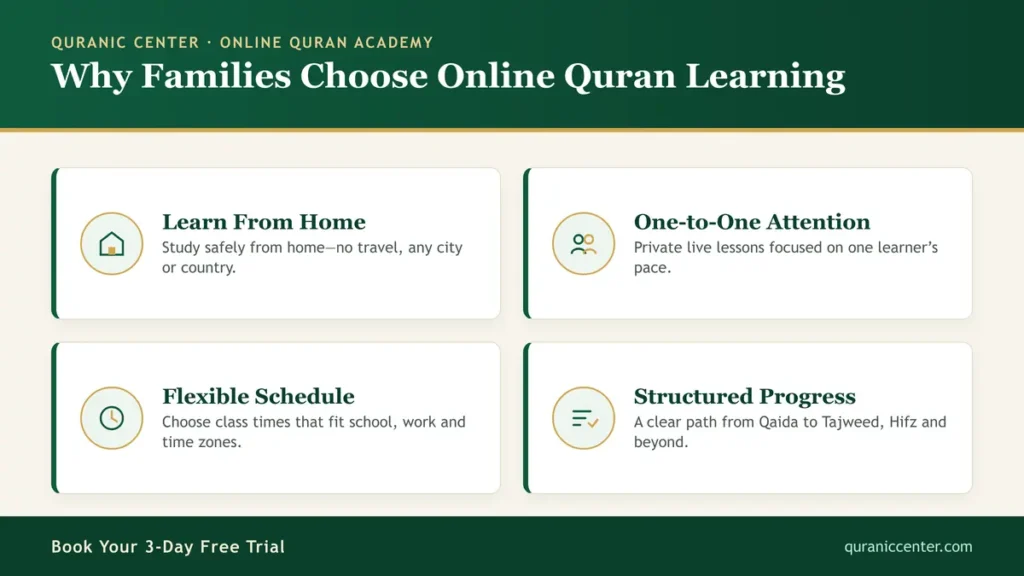
The most obvious benefit is convenience. There is no travel, no traffic and no waiting around — the class comes to you. Children learn from the comfort and safety of their own home, with a parent nearby if they wish. This is especially reassuring for young learners and for families who prefer a private, supervised environment rather than sending children out for evening lessons.
2. One-to-one live classes with real attention
In a crowded classroom a single teacher may be responsible for many students at once, and shy learners can easily be overlooked. Online classes are usually delivered live and one-to-one, so the entire lesson is built around a single student. The teacher can hear every letter, correct pronunciation on the spot, and move at exactly the right pace — slowing down where a learner struggles and moving ahead once a concept is mastered. That focused feedback is one of the fastest ways to improve recitation.
3. Flexible timings that fit your routine
Online learning bends around your life instead of forcing your life to bend around it. You can book lessons early in the morning before school, in the evening after work, or on weekends. Families living in different time zones can find a slot that works no matter where they are. If something comes up, classes can often be rescheduled rather than simply missed — which makes it far easier to stay consistent over months and years.
Why families choose online Quran learning — Quranic Center
4. Access to qualified, certified tutors
When you are limited to local teachers, you take whoever is available. Online, you can be matched with a tutor who genuinely fits your goals — for example a Hafiz or Hafiza for memorisation, or a certified Qari or Qaria for Tajweed. Many families also prefer a female teacher for their daughters, which is simple to arrange online. The result is a better match between the student and the teacher, and that usually means better progress.
5. A structured path — from Qaida to Tajweed and Hifz
Good online academies do not teach at random. They follow a clear progression: starting with the Basic Tajweedi Qaida for beginners, moving on to fluent reading with Tajweed, and then to advanced goals such as Quran memorisation (Hifz) or advanced Tajweed. Because each stage builds on the last, learners always know what they are working towards and can see how far they have come.
6. A comfortable environment for women and children
Many adult learners — especially women — feel more at ease studying from home than attending a physical class. Online lessons remove that hesitation entirely. Mothers can learn alongside their children, beginners can practise without feeling self-conscious, and the whole family can build a habit of daily recitation together in a familiar, private space.
7. Clear progress tracking and parent updates
Because lessons are organised and regular, progress is easy to follow. Teachers keep track of what has been covered — new lessons (sabaq), recent revision (sabqi) and older revision (manzil) for memorisation students — and share updates so parents always know how their child is doing. That steady feedback loop keeps learners motivated and accountable.
8. Affordable and accessible from anywhere
Without the cost of travel or physical premises, online classes are often more affordable than traditional options, and you can compare clear fee plans before you commit. Whether you live in a small town or a country with few Islamic schools, a quality Quran education is only an internet connection away.
Are there any drawbacks? An honest look
Online learning is not magic, and it is fair to know the trade-offs. A stable internet connection is essential, and very young children may need a parent to help them settle in for the first few sessions. Some learners also miss the social atmosphere of a physical class. The good news is that these are easy to manage: a quiet corner, a charged device and a short, consistent daily routine solve most of them — and a good teacher keeps young learners engaged throughout the lesson.
How to choose the right online Quran academy
Not every platform is the same. Before you enrol, it helps to check a few things:
- Qualified teachers: Ask about tutors’ qualifications and whether Hafiz/Hafiza and certified Qari/Qaria teachers are available.
- A free trial: A trustworthy academy lets you try a class before you pay, so you can judge the teaching for yourself.
- One-to-one lessons: Confirm that classes are private and live, not pre-recorded.
- Clear curriculum and fees: Look for a defined syllabus and transparent, upfront pricing.
- Flexible scheduling: Make sure lesson times can fit your family’s routine and time zone.
- Female teachers on request: Important for many families choosing lessons for daughters or mothers.
Frequently asked questions
- Are online Quran classes as effective as in-person lessons? Yes — for most learners they are just as effective, and often more so. Live one-to-one attention, consistent scheduling and a structured curriculum help students progress steadily. The teacher hears every letter and corrects pronunciation in real time.
- What age is right to start online Quran classes? Children can usually begin around four or five years old with the Basic Qaida, and there is no upper limit — many adults start later in life and do very well. Lessons are tailored to each learner’s age and level.
- Do I need any special equipment? Just a smartphone, tablet or computer with a camera and a stable internet connection. A quiet space and a copy of the Quran (physical or digital) are all you need to get started.
- Can girls and women learn from a female teacher? Yes. Female Hafiza and Qaria teachers are available on request, so mothers and daughters can learn in a comfortable, appropriate environment.
- Can I try a class before enrolling? Yes. We offer a free trial so you can experience the teaching style and meet your tutor before making any commitment.
- Which courses can I take online? From the Basic Tajweedi Qaida for beginners to reading with Tajweed, Quran memorisation (Hifz), advanced Tajweed, translation and Islamic studies — you can explore them all on our courses page.
Start learning with Quranic Center
The advantages of online Quran classes come down to one thing: they make consistent, high-quality Quran learning possible for almost anyone, anywhere. With flexible timings, one-to-one live lessons and qualified teachers, your family can begin — and keep going — without the usual barriers.
Explore our full range of courses, or book your free trial today and take the first step with a teacher who is ready to help you succeed.
