
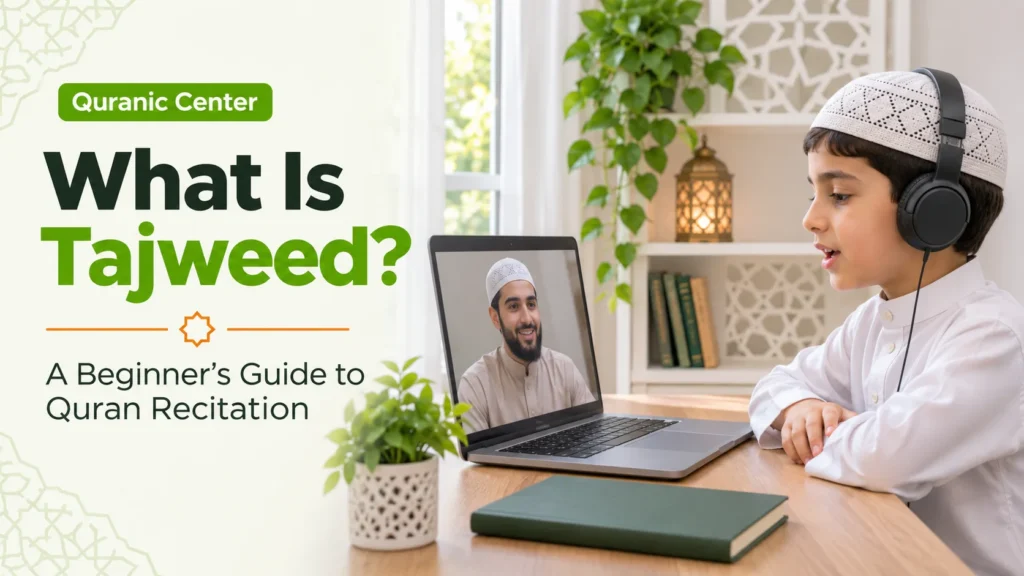
What is Tajweed? It is the practical way of learning to pronounce the letters and words of the Quran correctly. Tajweed teaches a reader where each letter comes from, how it should sound, when a vowel should be lengthened, and where to pause or continue. These skills develop through listening, guided recitation, regular practice and correction from a teacher.
For beginners, Tajweed can look complicated at first, but it does not have to be learned all at once. A good teacher starts with the learner’s actual reading level, introduces one point at a time and gives enough practice before moving forward.
What Does Tajweed Mean?
The word Tajweed carries the meaning of improving or making something excellent. In Quran recitation, it refers to reading with careful pronunciation and applying the established rules that govern letters, sounds, elongation, merging, concealment and pauses.
Tajweed is not simply about making the voice sound beautiful. Its first purpose is accurate recitation. A pleasant voice may support the experience, but correct articulation and careful reading come first.
Why Is Tajweed Important?
Tajweed helps learners:
- pronounce Arabic letters from their correct articulation points
- distinguish between letters that may sound similar to a beginner
- observe the correct length of vowels
- apply rules connected with Noon Sakinah, Tanween and Meem Sakinah
- stop and begin at suitable places
- recognise and gradually correct repeated recitation mistakes; and
- build confidence through supervised practice
Tajweed should be taught without unrealistic promises. Progress depends on the learner’s starting level, regularity, listening ability, practice and response to correction.
What Are the Main Tajweed Areas for Beginners?
1. Makharij: Articulation Points
Makharij are the places from which Arabic letters are pronounced. These involve areas such as the throat, tongue, lips and nasal passage. A teacher may begin by helping the learner hear and produce letters that are often confused.
2. Sifaat: Qualities of Letters
Sifaat are the characteristics associated with Arabic letters. They help explain why two letters produced near each other can still sound different. Beginners usually learn these qualities through demonstration and repetition rather than theory alone.
3. Noon Sakinah and Tanween
Learners are introduced gradually to the main applications commonly known as Izhar, Idgham, Iqlab and Ikhfa. The correct application depends on the letter that follows.
4. Meem Sakinah
Rules connected with a non-vowelled Meem help learners understand when the sound is clear, concealed or merged.
5. Madd
Madd concerns the lengthening of vowel sounds. Beginners learn to recognise where elongation occurs and practise the required timing with a teacher.
6. Ghunnah
Ghunnah is a nasal sound used in specific situations. It should be learned by listening and practising because written explanations alone may not show the correct sound or duration.
7. Qalqalah
Qalqalah involves an echo-like quality on particular letters in defined conditions. The sound should be controlled and should not create an extra vowel.
8. Waqf and Ibtida
Waqf and Ibtida refer to stopping and beginning. Learners need guidance on where a pause is suitable and how to resume without damaging the flow or intended meaning.

What Is a Tajweed Quran?
A Tajweed Quran is commonly a printed or digital Mushaf that uses colour coding or other visual marks to help readers recognise selected recitation rules. It can support revision, but the colours may differ between publishers and do not replace listening, guided explanation or correction from a teacher.
Tajweed and Tarteel: Are They the Same?
The terms are related but not identical. Tajweed focuses on the rules and practical accuracy of pronunciation. Tarteel refers to measured, clear and thoughtful recitation. A learner can work toward careful Tarteel by improving pronunciation, observing pauses and applying Tajweed consistently.
Common Tajweed Mistakes Beginners Make
Common difficulties may include:
- confusing similar Arabic letters
- reading a short vowel as a long vowel or the reverse
- adding an extra sound to a letter
- missing or exaggerating Ghunnah
- applying Madd for an inconsistent length
- ignoring a Shaddah
- stopping where the phrase is incomplete
- reading too quickly to apply corrections; and
- memorising a rule without recognising it during recitation
Mistakes should be corrected according to the learner’s level. Too many corrections at once can be discouraging, while no correction allows habits to become fixed. A balanced lesson selects the most important issue, practises it and reviews it in later recitation.
Can You Learn Tajweed by Yourself?
Books, recordings and apps can help you understand terms and hear examples. However, they may not reveal whether your own pronunciation is accurate. Live feedback is especially useful for Makharij, letter qualities, Ghunnah, Madd and repeated personal errors.
A practical approach is to use learning materials for review while reciting regularly to a suitable teacher who can listen and correct.
How to Learn Tajweed Step by Step
- Check your current reading level. Determine whether you need Arabic-letter foundations, joining practice, fluency work or direct Tajweed training.
- Strengthen difficult letters. Practise the articulation of letters you regularly confuse.
- Study one rule at a time. Learn a simple definition, listen to examples and find the rule in short passages.
- Recite to a teacher. Receive immediate correction instead of relying only on self-assessment.
- Repeat corrected words and verses. Correction becomes useful when the improved form is practised.
- Keep a small error list. Record recurring issues for focused revision.
- Review consistently. Short, regular practice is usually more manageable than occasional long sessions.
- Apply rules in normal recitation. The goal is not only to name a rule but to use it correctly while reading.
How Long Does It Take to Learn Tajweed?
There is no single completion time for every student. A learner who already reads Arabic fluently may focus directly on pronunciation and rules. A complete beginner may first need Qaida, letter recognition and joining practice.
Age, attendance, practice and the number of recurring errors also affect progress. A responsible course should assess the learner before giving a study plan and should not promise mastery within a fixed number of days.
Can Children Learn Tajweed?
Yes. Children can learn Tajweed when lessons match their age and reading level. Young beginners may start with letter sounds, short vowels and joining before moving to formal rule names. Repetition, short practice, encouragement and parent awareness can support steady improvement.
Can Adults Start Tajweed as Beginners?
Yes. Adults may begin from Arabic letters, a basic Qaida level or an existing Quran-reading level. The teacher should identify the learner’s starting point and focus on practical correction without assuming prior knowledge.
How Online Tajweed Lessons Work
In a one-to-one online lesson, the student recites live while the tutor listens. The tutor can demonstrate a sound, ask the student to repeat it, identify recurring errors and assign focused practice.
Quranic Center offers one-to-one online learning for children and adults, subject to tutor and schedule availability. Learners may begin with a free 3-day trial so the team can understand their level, preferred course and suitable time before confirming an arrangement.
Learners who need stronger foundations can begin with Basic Tajweedi Qaida. Those who already read and want guided correction can explore the Quran With Tajweed course. Parents may also review our online Quran classes for kids and the Academic System.
Frequently Asked Questions
What is Tajweed in simple words?
Tajweed is the practical system for pronouncing Quranic letters and words correctly. It includes articulation points, letter qualities, vowel lengths, nasal sounds, merging and concealment rules, and suitable places to stop and begin.
Is Tajweed only for advanced students?
No. Tajweed can be introduced from the beginning at an age-appropriate level. New learners often start with correct letter sounds and short vowels, while fluent readers may move directly to detailed rules and correction.
What should a beginner learn first in Tajweed?
The starting point depends on reading ability. Many beginners first strengthen Arabic letters, Makharij, short vowels, joining and basic fluency. The teacher then introduces commonly used rules gradually.
What is the difference between Makharij and Tajweed?
Makharij are the articulation points from which letters are pronounced. Tajweed is broader: it includes Makharij as well as letter qualities, vowel lengths, nasalisation, merging, concealment, stopping and other recitation principles.
Can I learn Tajweed online?
Yes. Live online lessons can support Tajweed learning because a tutor can listen, demonstrate sounds and correct the student in real time. The quality of feedback and regular practice matter more than simply watching recorded material.
Do I need to know Arabic to learn Tajweed?
You do not need to speak Arabic fluently, but you need to recognise and pronounce Quranic letters. A complete beginner can start with Qaida and gradually progress to connected reading and applied Tajweed.
How often should I practise Tajweed?
Regular practice is more useful than rare, rushed sessions. The exact routine depends on age and schedule, but learners should repeat corrected words and short passages between lessons.
Does a beautiful voice mean a person has good Tajweed?
Not necessarily. A pleasant voice and accurate Tajweed are different. Tajweed is assessed through correct pronunciation and application of recitation rules, not voice quality alone.
Start Learning with Guided Correction
If you want to improve Quran reading, begin with an assessment of your current level. Share whether you are a child, adult or complete beginner, which areas feel difficult and what lesson times suit you.
